Skeleton 4,000 Years Old Bears Evidence of Leprosy
Where leprosy came from--and how it entered Europe--has been a mystery. Now, evidence from a bear skeleton points up a possible link with an important historical figure:
...The skeleton, about 4,000 years old, was found at the site of Balathal, near Udaipur in northwestern India. Historians have long considered the Indian subcontinent to be the source of the leprosy that was first reported in Europe in the fourth century B.C., shortly after the armies of Alexander the Great returned from India.
In addition, ancient religious texts now demonstrate some medical significance:
...The authors say their find confirms that a passage in the Atharva Veda, a set of Sanskrit hymns written around 1550 B.C., indeed refers to leprosy, a reading that had been doubted because until now the oldest accepted written accounts of the disease were from the sixth century B.C.
Showing posts with label greece. Show all posts
Showing posts with label greece. Show all posts
Wednesday, May 27, 2009

Friday, December 12, 2008
Going to Babylon

Beyond Babylon
This weekend I'm visiting the Metropolitan Museum of Art with a number of our Coven members. I'm particularly excited about the "Beyond Babylon" exhibit. There was a good review of it in the NYTimes entitled "Global Exchange, Early Version". From the article, something I'm really looking forward to seeing:
"...a ceramic goddess with wings and talons for feet is an exuberant arrival from cultural sources unknown...Referred to by archaeologists as “The Queen of the Night,” she is so hybrid a creation that she was at one time labeled a fake. She is now considered authentic, but authentically what is the question..."
A good portion of the exhibit focus on the remarkable artifacts recovered from a ship wreck:
...For a truly cornucopian example of multiculturalism, though, nothing matches the contents of the Late Bronze Age merchant ship recovered from the sea off the southern coast of Turkey...it probably sank around 1300 B.C., packed with cargo representing a dozen cultures, from Nubia to the Balkans...Although the ship’s home port is unknown, it appears to have traveled a circular route through the Mediterranean and Aegean, stopping in Greece, Crete, Turkey, Syria and Egypt, picking up and unloading as it went. Bulk materials included copper ingots, Cypriot pottery, African wood and Near Eastern textiles, all for waiting markets...Divers also found luxury items, possibly personal possessions of the ship’s crew and passengers. Examples of ivory containers in the form of ducks have parallels with Egyptian prototypes, but were probably made in Mediterranean Asia. The two sources merge in a figure found in a tomb: a nude female swimmer with a chic, Nile-style pageboy who is hitching a ride behind an ivory-headed bird...
Follow the link for the NYTimes article for a pic of the swimmer and her bird friend.
Monday, December 1, 2008
Changing Museum Policies
How Did That Vase Wind Up in the Metropolitan?
I've blogged before about the repatriation of pilfered artifacts . Today there's an Opinion piece in NYTimes by Sharon Waxman, who is the author of “Loot: The Battle Over the Stolen Treasures of the Ancient World.”. It seems the new director of the MET (Thomas Campbell) has the opportunity (according to Sharon Waxman) to set a new course when dealing with artifacts of dubious origin. New guidelines are being issued by and association of museums:
...This past summer, the association finally issued new guidelines, which recognize that buying unprovenanced antiquities encourages their illicit trade and recommend that its members purchase only antiquities that can be proven to have been legally exported after 1970, or else removed from their country of origin before that date. (It was in 1970 that Unesco adopted an international convention barring the illegal export and transfer of cultural property....
Sharon Waxman continues:
...The Metropolitan needs to come clean about its past of appropriation of ancient art in the late 19th and early 20th centuries. And it needs to tell a much fuller story about its more recent role in purchasing looted and smuggled antiquities...
She feels the new director of the MET, Thomas Campbell, can:
...inaugurate a new era of transparency for all museums, and to recalibrate the Met’s relations with countries that feel aggrieved...By publicly acknowledging the controversial or otherwise dubious histories of some artifacts and by making the recent past as much a part of the artifacts’ stories as the ancient past, Mr. Campbell can set an example for all museums and build new bridges of respect and cooperation...Transparency may not end every demand for repatriation. But it will disarm those critics in source countries who know — but rarely acknowledge — that regardless of past transgressions, their treasures may be safer, better preserved and more widely adored in the world’s great museums like the Met...
I've blogged before about the repatriation of pilfered artifacts . Today there's an Opinion piece in NYTimes by Sharon Waxman, who is the author of “Loot: The Battle Over the Stolen Treasures of the Ancient World.”. It seems the new director of the MET (Thomas Campbell) has the opportunity (according to Sharon Waxman) to set a new course when dealing with artifacts of dubious origin. New guidelines are being issued by and association of museums:
...This past summer, the association finally issued new guidelines, which recognize that buying unprovenanced antiquities encourages their illicit trade and recommend that its members purchase only antiquities that can be proven to have been legally exported after 1970, or else removed from their country of origin before that date. (It was in 1970 that Unesco adopted an international convention barring the illegal export and transfer of cultural property....
Sharon Waxman continues:
...The Metropolitan needs to come clean about its past of appropriation of ancient art in the late 19th and early 20th centuries. And it needs to tell a much fuller story about its more recent role in purchasing looted and smuggled antiquities...
She feels the new director of the MET, Thomas Campbell, can:
...inaugurate a new era of transparency for all museums, and to recalibrate the Met’s relations with countries that feel aggrieved...By publicly acknowledging the controversial or otherwise dubious histories of some artifacts and by making the recent past as much a part of the artifacts’ stories as the ancient past, Mr. Campbell can set an example for all museums and build new bridges of respect and cooperation...Transparency may not end every demand for repatriation. But it will disarm those critics in source countries who know — but rarely acknowledge — that regardless of past transgressions, their treasures may be safer, better preserved and more widely adored in the world’s great museums like the Met...
Thursday, September 4, 2008
More Greek art returns home
Greece Welcomes Return of Antiquities
I previously blogged about the return of a krater and two acroliths. It's great to see this happening more and more:
...On Wednesday Greece celebrated the return of two rare antiquities, Reuters reported. The items, a bronze vase from the fourth-century B.C. and the upper part of a marble tombstone, have been put on display at the National Archaeological Museum in Athens...Archaeologists previously feared the pieces would never be reunited. “Fortunately, the archaeologists’ prediction was wrong,” Michalis Liapis, the culture minister, told reporters at the museum...
I previously blogged about the return of a krater and two acroliths. It's great to see this happening more and more:
...On Wednesday Greece celebrated the return of two rare antiquities, Reuters reported. The items, a bronze vase from the fourth-century B.C. and the upper part of a marble tombstone, have been put on display at the National Archaeological Museum in Athens...Archaeologists previously feared the pieces would never be reunited. “Fortunately, the archaeologists’ prediction was wrong,” Michalis Liapis, the culture minister, told reporters at the museum...
Wednesday, July 30, 2008
The Antkythera Mechanism keeps rocking
Discovering How Greeks Computed In 100 B.C.
More and more is being deciphered about the amazing 'Antkythera Mechanism':
...After a closer examination of a surviving marvel of ancient Greek technology known as the Antikythera Mechanism, scientists have found that the device not only predicted solar eclipses but also organized the calendar in the four-year cycles of the Olympiad, forerunner of the modern Olympic Games...Only now, applying high-resolution imaging systems and three-dimensional X-ray tomography, have experts been able to decipher inscriptions and reconstruct functions of the bronze gears on the mechanism. The latest research has revealed details of dials on the instrument’s back side, including the names of all 12 months of an ancient calendar...
More and more is being deciphered about the amazing 'Antkythera Mechanism':
...After a closer examination of a surviving marvel of ancient Greek technology known as the Antikythera Mechanism, scientists have found that the device not only predicted solar eclipses but also organized the calendar in the four-year cycles of the Olympiad, forerunner of the modern Olympic Games...Only now, applying high-resolution imaging systems and three-dimensional X-ray tomography, have experts been able to decipher inscriptions and reconstruct functions of the bronze gears on the mechanism. The latest research has revealed details of dials on the instrument’s back side, including the names of all 12 months of an ancient calendar...
Monday, May 12, 2008
Soft vs Hard
Isims and Schisms
Livia over at MagicHills has some interesting thoughts on "soft" vs "hard" polytheism:
...But I see all of that "all are one" stuff that I was bombarded with in my early studies as trite oversimplification that limited my perception and worship of the gods...Now that I've got a few years of study and practice under my belt I see that my past soft polytheism was really a hangover from my knowledge and experience of monotheism. I think soft polytheism made the transition from Christianity to neopaganism easier: one god, to one goddess, to a goddess and a god and now to many distinct deities...I see all gods as unique and distinct beings who are each worthy of study, reflection and worship. Hard polytheism isn't easy for me like soft polytheism was; I have to work harder, study more and think more. And I wouldn't have it any other way.
I agree with Livia that it's good to focus on individual gods and goddesses, and I like her distinction between the two types of polytheism. But those darn gods and goddesses have a hand in this as well. The characteristics of deities can mix and blend through time, and one can even absorb another. In addition, cultures can sometimes try to make sense of a complicated theology by simplifying it, such as the Greeks did when they tried to order and explain Egyptian mythology, in terms of the Greek pantheon and philosophy.
Livia over at MagicHills has some interesting thoughts on "soft" vs "hard" polytheism:
...But I see all of that "all are one" stuff that I was bombarded with in my early studies as trite oversimplification that limited my perception and worship of the gods...Now that I've got a few years of study and practice under my belt I see that my past soft polytheism was really a hangover from my knowledge and experience of monotheism. I think soft polytheism made the transition from Christianity to neopaganism easier: one god, to one goddess, to a goddess and a god and now to many distinct deities...I see all gods as unique and distinct beings who are each worthy of study, reflection and worship. Hard polytheism isn't easy for me like soft polytheism was; I have to work harder, study more and think more. And I wouldn't have it any other way.
I agree with Livia that it's good to focus on individual gods and goddesses, and I like her distinction between the two types of polytheism. But those darn gods and goddesses have a hand in this as well. The characteristics of deities can mix and blend through time, and one can even absorb another. In addition, cultures can sometimes try to make sense of a complicated theology by simplifying it, such as the Greeks did when they tried to order and explain Egyptian mythology, in terms of the Greek pantheon and philosophy.
Tuesday, May 6, 2008
Our Gods take plastic
Appeasing the Gods, With Insurance
This NY Times article explores how even the most ratinal among us emply 'magical thinking' to insure a good outcome, much like the Ancient Greeks tried to appease their gods through sacrafice:
...We buy insurance not just for peace of mind or to protect ourselves financially, but because we share the ancient Greeks’ instinct for appeasing the gods...“It is an irony of the post-Enlightenment world...that so many people who don’t believe in fate refuse to tempt it...”
I've commented before how even scientists believe in luck and rely on 'gut feelings'. But I never envisioned insurance policies as protective talismans, but it seems some people do:
...Even people who consciously reject superstitions seem to have these gut feelings, says Orit Tykocinski, a professor of psychology at the Interdisciplinary Center Herzliya in Israel. She found that rationalists were just as likely as superstitious people to believe that insurance would ward off accidents...So when we think about passing up flight insurance, we conjure up disaster just as easily as ancient Greeks imagined a thunderbolt from Olympus...
This NY Times article explores how even the most ratinal among us emply 'magical thinking' to insure a good outcome, much like the Ancient Greeks tried to appease their gods through sacrafice:
...We buy insurance not just for peace of mind or to protect ourselves financially, but because we share the ancient Greeks’ instinct for appeasing the gods...“It is an irony of the post-Enlightenment world...that so many people who don’t believe in fate refuse to tempt it...”
I've commented before how even scientists believe in luck and rely on 'gut feelings'. But I never envisioned insurance policies as protective talismans, but it seems some people do:
...Even people who consciously reject superstitions seem to have these gut feelings, says Orit Tykocinski, a professor of psychology at the Interdisciplinary Center Herzliya in Israel. She found that rationalists were just as likely as superstitious people to believe that insurance would ward off accidents...So when we think about passing up flight insurance, we conjure up disaster just as easily as ancient Greeks imagined a thunderbolt from Olympus...
Friday, March 28, 2008
Hypatia: The Movie
Hypatia Comes to the Screen
Article over by Jason over at Wild Hunt about the upcoming movie about the female philosopher Hypatia of Alexandria:
...This film, more than any other recent film set during the classical period, will be closely watched by modern Pagans (especially Hellenic reconstructionists). Many of whom consider Hypatia to be one of the primary martyrs of pre-Christian pagan religion...
Many of us were first enlightened about Hypatia by Carl Sagan in his series Cosmos. The movie is being handled by a good director who is passionate about the material, so there's a good chance this will turn out well.
Article over by Jason over at Wild Hunt about the upcoming movie about the female philosopher Hypatia of Alexandria:
...This film, more than any other recent film set during the classical period, will be closely watched by modern Pagans (especially Hellenic reconstructionists). Many of whom consider Hypatia to be one of the primary martyrs of pre-Christian pagan religion...
Many of us were first enlightened about Hypatia by Carl Sagan in his series Cosmos. The movie is being handled by a good director who is passionate about the material, so there's a good chance this will turn out well.
Friday, March 14, 2008
Jason and the Argonauts
WINE, WORSHIP AND SACRIFICE: The Golden Graves of Ancient Vani
Of course, the story of Jason and the Argonauts has some basis in fact:
...Ancient Greeks did sail across the sea — the Black Sea — to Colchis (modern-day Georgia), a land rich in gold and other precious metals. It seems the Colchians had a technique, involving sheepskins, for extracting gold dust from running water — hence, the Golden Fleece...
You'll learn even more about Colchis if you visit the exhibt at the Institute for the Study of the Ancient World, at 15 East 84th Street, in Manhattan:
...In two small galleries the exhibition presents more than 100 objects unearthed on the site of Vani, a major Colchian city founded in the eighth century B.C. There is beautiful, intricate gold jewelry that once adorned the bodies of luminaries in their graves, where they were buried with many possessions, including slaves and pets. Wine vessels were commonly found in graves, too, as wine production and consumption were central to the Colchian economy...
Of course, the story of Jason and the Argonauts has some basis in fact:
...Ancient Greeks did sail across the sea — the Black Sea — to Colchis (modern-day Georgia), a land rich in gold and other precious metals. It seems the Colchians had a technique, involving sheepskins, for extracting gold dust from running water — hence, the Golden Fleece...
You'll learn even more about Colchis if you visit the exhibt at the Institute for the Study of the Ancient World, at 15 East 84th Street, in Manhattan:
...In two small galleries the exhibition presents more than 100 objects unearthed on the site of Vani, a major Colchian city founded in the eighth century B.C. There is beautiful, intricate gold jewelry that once adorned the bodies of luminaries in their graves, where they were buried with many possessions, including slaves and pets. Wine vessels were commonly found in graves, too, as wine production and consumption were central to the Colchian economy...
Saturday, January 12, 2008
Krater flies home

Ciao to a Met Prize Returning to Italy
The other day I posted about the return of two Greek acroliths that had been acquired under dubious circumstances. Now another antiquity is returning home, this time one of considerable fame:
...In the coda to a long tug of war, the Metropolitan Museum of Art is bidding goodbye to the Euphronios krater, a 2,500-year-old vessel that has been a showpiece of its collection for more than three decades. Sunday is the last viewing day...
The Krater was prominently displayed at the MET, and had been a icon for art history students and Pagans for years. Just as life imitates myth depicted by acroliths, the Krater has the speedy messenger God Hermes depicted on one side. So the Krater returns home in good hands.
(Image from AncientWorlds, which has a good article on the Krater.)
Thursday, January 10, 2008
Greek Goddesses return home

U.Va. to Return Looted Greek Statues to Italy
It's always good hearing about the repatriation of treasured antiquities:
...The University of Virginia plans to return two ancient Greek sculptures to Italy nearly three decades after tomb raiders looted them from Sicily...The acroliths of the Greek goddesses were created about 525 B.C. out of cloth, wood and marble...The life-size statues were originally displayed inside a temple in Morgantina, an ancient Greek settlement near what is now the Italian city of Aidone. They are thought to represent Demeter, the Greek goddess of agriculture and grain, and her daughter Persephone, the queen of the underworld...
According to U.Va. art history professor Malcolm Bell, the return of the acroliths is especially appropriate because:
...the myths of Demeter and Persephone involved themes of traveling and returning. After Persephone is kidnapped and taken to the underworld, her mother searches for her across the Earth. Meanwhile, Persephone returns to Earth once a year, heralding spring and rebirth...
The Goddess must be very pleased! Additional article here.
___
Saturday, December 8, 2007
I want my Zeus TV!

Greek Gods Come to Television
Jason over at Wild Hunt asks:
...Is the world ready for a comedy television series starring Zeus, Dionysus, Apollo, and Artemis...?
I don't know. I always look at these things with a mix of anticipation and dread.
Monday, October 29, 2007
Greek and Roman Gods were best!

Bring back the Greek gods: Mere mortals had a better life when more than one ruler presided from on high.
Excellent opinion piece by Mary Lefkowitz, author of ""Greek Gods, Human Lives".:
...Prominent secular and atheist commentators have argued lately that religion "poisons" human life and causes endless violence and suffering. But the poison isn't religion; it's monotheism...
I could not agree more! It's great that a respected historian with a PhD after her name is finally saying it.
...The polytheistic Greeks didn't advocate killing those who worshiped different gods, and they did not pretend that their religion provided the right answers. Their religion made the ancient Greeks aware of their ignorance and weakness, letting them recognize multiple points of view...
...The world, as the Greek philosopher Thales wrote, is full of gods, and all deserve respect and honor. Such a generous understanding of the nature of divinity allowed the ancient Greeks and Romans to accept and respect other people's gods and to admire (rather than despise) other nations for their own notions of piety. If the Greeks were in close contact with a particular nation, they gave the foreign gods names of their own gods: the Egyptian goddess Isis was Demeter, Horus was Apollo, and so on. Thus they incorporated other people's gods into their pantheon...
Lefkowitz rightfully points out the the Romans certainly persecuted the early Christians. But they were perceived more as insurgents and terrorists, working to undermine social order, than just members of some obscure religious cult.
...Ancient Greek religion gives an account of the world that in many respects is more plausible than that offered by the monotheistic traditions. Greek theology openly discourages blind confidence based on unrealistic hopes that everything will work out in the end. Such healthy skepticism about human intelligence and achievements has never been needed more than it is today...
That hits the nail on the head. When one finally abandons the paternalistic concept of godhead, many of the philosophical contradictions inherent in monotheism simply melt away.
It's such a relief to be done with monotheism.
(Image from the great Benny Hill tribute site Benny's Place.)
Sunday, January 21, 2007
Well crank my Antikythera!
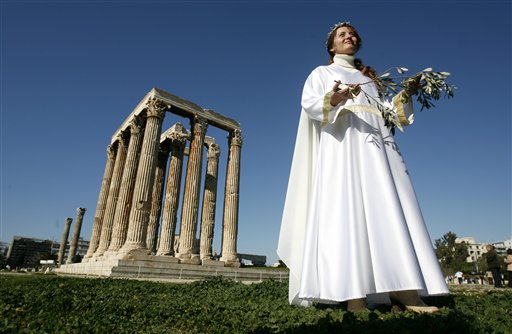
Ellinais only formed a short while ago, and already it is making international headlines:
(AP) A clutch of modern pagans honored Zeus at a 1,800-year-old temple in the heart of Athens on Sunday, the first known ceremony of its kind held there since the ancient Greek religion was outlawed..."We are Greeks and we demand from the government the right to use our temples," said high priestess Doreta Peppa...Ellinais was founded last year and has 34 official members, mainly academics, lawyers and other professionals...Unlike the monotheistic religions...the old religion lacked written ethical guidelines, but its gods were said to strike down mortals who displayed excessive pride or "hubris", a recurring theme in the tragedies of Euripides and other ancient writers...
The Wild Hunt has a good post with more links.
One of the high priests said:
"...We do not believe in dogmas and decrees, as the other religions do. We believe in freedom of thought..."
How refreshing. Thanx to Witchvox for this item
Tuesday, January 9, 2007
Exhibit of Greek and Spartan Artifacts
This summary is not available. Please
click here to view the post.
Subscribe to:
Posts (Atom)