Two weeks, there was a piece in the NYTimes about Carolyn Porco and her remarkable contributions in imaging the outer planets of our solar system. A protege of Carl Sagan, she is credited as being the model for the character Dr. Ellie Arroway in the book/movie "Contact". Definitely an interesting read.
But today there was an interesting letter called "Eyeing the Cosmos"in the NYTimes, inspired by the article:
...In pondering the possibility of life elsewhere in the cosmos, Dr. Porco echoes yet another august figure in her ancestral patrimony, Marcus Aurelius: “The entire Earth is but a point, and the place of our own habitation but a minute corner of it...
If you have not read Marcus Aurelius, I highly recommend the recent translation by Gregory Hays, "Meditations: Marcus Aurelius" This book belongs on the self of every well-read Pagan/Wiccan/Atheist.
Showing posts with label astronomy. Show all posts
Showing posts with label astronomy. Show all posts
Wednesday, September 30, 2009

Wednesday, February 4, 2009
Green Comet

Green Comet Approaches Earth
It would be great if this comet becomes visible to the naked eye. But even if it does not grow into something special (that catches the traditional media's attention), it probably will be amazing to behold in a small telescope or binoculars:
...The comet makes its closest approach to Earth (0.41 AU) on Feb. 24, 2009. Current estimates peg the maximum brightness at 4th or 5th magnitude, which means dark country skies would be required to see it. No one can say for sure, however, because this appears to be Lulin's first visit to the inner solar system and its first exposure to intense sunlight. Surprises are possible.
Thursday, January 15, 2009
A very bright Goddess
Go out and enjoy the planet Venus. She is amazingly bright right now. From the Jan 14th edition from spaceweather.com:
...HOURS OF VENUS: Today and for the rest of the week, Venus is at maximum elongation (greatest apparent distance) from the sun. This means the silvery planet is "up" for more than three hours after sunset. Go outside after dark, face south, and take a long look. Venus is so bright it outshines city lights and even pierces thin clouds. The view through a backyard telescope may surprise you. Check http://spaceweather.com for images and more information.
Yewtree sent me an interesting link about the "ashen" light of Venus. Keen observers have noted this phenomena from time to time.
Sunday, November 16, 2008
Meteors, and planets!
Very nice display, courteous nature. From SpaceWeather.com:
EVENING PLANETS: When the sun goes down tonight, step outside and look southwest. The two brightest planets, Venus and Jupiter, are shining through the twilight side by side. You'll want to keep an eye on these two because they are drawing noticeably closer together every night.  Venus and Jupiter are converging on a patch of sky in Sagittarius where they will have a spectacular double-conjunction with the Moon at the end of the month. Don't wait until then, though. Visit http://spaceweather.com for sky maps and start watching now.

LEONID METEOR WATCH:  The Leonid meteor shower peaks this year on Nov. 17th and 18th.  Bright moonlight will probably spoil the show, but not necessarily.  Researchers who study Comet 55P/Tempel-Tuttle, the source of the Leonids, say Earth is going to pass through one or two of the comet's dusty filaments.  Peak rates of 20 to 100 meteors per hour are possible during the early hours of Nov. 17th (especially 0000-0200 UT) and again during the waning hours of Nov. 18th (around 2130 UT).  These times favor sky watchers in Europe, Africa, and Asia.  Smaller numbers of Leonids could appear between the anticipated peak times. Meteor enthusiasts everywhere should monitor the sky on Nov. 17th and 18th; the hours before local dawn are usually best.
Friday, August 8, 2008
08' Perseid Meteor Shower
From Spaceweather.com:
...COUNTDOWN TO THE PERSEIDS: The annual Perseid meteor shower peaks one week from today, on Tuesday, August 12th. The best time to look is during the dark hours before dawn on Tuesday morning when forecasters expect 50 to 100 meteors per hour. Get away from city lights if you can; plan a camping trip! The darker the sky, the more meteors you will see...The source of the Perseids is Comet Swift-Tuttle, which has littered the August portion of Earth's orbit with space dust. The dusty zone is broad and Earth is already in its outskirts. As a result, even before the peak on August 12th, you may see some "early Perseids" streaking across the night sky...
Driving home from our Lammas Sabbat/UUA vigil the other night, Aug 3rd, I saw a very bright meteor. It was a very clear and beautiful night and Jupiter had been holding court. The meteor appeared fairly high up and too my left (I was traveling due south). There was a distinct arch to it's trajectory, which seemed to grow steeper as it fell to earth. I have the impression it may have landed somewhere, or at least it dipped below the southwestern horizon. But the most remarkable thing about it was that it developed a emerald glow just before I lost sight of it.
Thursday, July 31, 2008
Hands off the Astrolabe!
British Museum buys medieval astronomy tool
A mere toy when compared to the Greek Antkythera Mechanism:
...LONDON - A rare astronomy tool that helped medieval scientists tell time will remain in Britain after the British Museum scrambled to come up with the money to buy it. The brass device, called an astrolabe quadrant, had been sold at auction last year, and the museum was outbid. But money from the National Heritage Memorial fund, The Art Fund and the British Museum Friends helped the museum purchase it recently for 350,000 pounds ($700,000)...
But seriously, it's sad that museums have to scramble to scrape up funds to preserve national treasures. Astrolabes were a critical tool in astronomy and astrology. A similar situation is happening at the world's libraries. Over at Wildhunt, there's an interesting post about the possible breakup of an occult book collection:
"...A remarkable collection of rare and ancient volumes on the arts of magic and summoning ghosts could be broken up and sold off due to a funding crisis. The Harry Price Library of Magical Literature, based at the University of London, is the UK's largest of its kind ...
Tuesday, July 15, 2008
EO Wilson, of Ants and Humans
Taking a Cue From Ants on Evolution of Humans
Harvard entomologist EO Wilson just celebrated his birthday. He is in his 80's, yet does not shy away from a fight, although he rarely goes looking for one. But this is an exception:
...The issue is the level at which evolution operates. Many evolutionary biologists have been persuaded, by works like “The Selfish Gene” by Richard Dawkins, that the gene is the only level at which natural selection acts. Dr. Wilson, changing his mind because of new data about the genetics of ant colonies, now believes that natural selection operates at many levels, including at the level of a social group....
Soon after Wilson and co-author David Sloan Wilson published this work, they were attacked by Richard Dawkins:
...Their statement evoked a heated response from Dr. Dawkins in New Scientist; he accused them of lying on a minor point and demanded an apology...
You know you must be on the right track, when you illicit personal attacks from Atheist front-man Dawkins! Wilson's hypothesis basically boils down to this:
...It is through multilevel or group-level selection — favoring the survival of one group of organisms over another — that evolution has in Dr. Wilson’s view brought into being the many essential genes that benefit the group at the individual’s expense. In humans, these may include genes that underlie generosity, moral constraints, even religious behavior. Such traits are difficult to account for, though not impossible, on the view that natural selection favors only behaviors that help the individual to survive and leave more children...
This flies in the face of "selfish gene" advocates (like Dawkins) who at best feel religion and spirituality are archaic traits of no use today (such as our appendix), or at worst dangerous virus-like mutations which need to be immunized against.
“...Groups with men of quality — brave, strong, innovative, smart and altruistic — would tend to prevail, as Darwin said, over those groups that do not have those qualities so well developed,” Dr. Wilson said...“I believe that deep in their heart everyone working on social insects is aware that the selection that created them is multilevel selection,” Dr. Wilson said...
Don't you love that a fellow who studies ants (well, admittedly he is the world's leading authority on the critters) can cause such a ruckus!
I always encourage any new Pagan or Wiccan to immerse themselves in the study of nature. Pick some '...ology' and read all you can on it. Birding is great. So is gardening. How 'bout rocks and minerals? But in my humble opinion, the two most valuable fields to embrace are entomology and astronomy. And both are open to people of limited funds and time, and amateurs are welcome and can even make contributions.
Wednesday, July 9, 2008
Zeus is close
Get out your optical aids and get under the night sky. From SpaceWeather.com:
...JUPITER AT ITS BRIGHTEST: Jupiter reaches maximum brilliance this week, on July 9th, when it makes its closest approach to Earth for all of 2008. At sunset, look low and southeast for a beacon of light brighter than any star. That is Jupiter rising for an all-night transit across the southern sky. During this time of closest approach, Jupiter makes a wonderful target for backyard telescopes. Even small telescopes reveal the planet's cloud belts, its four largest moons, and the Great Red Spot, an anti-cyclone twice as wide as Earth. Just a few days ago, the Great Red Spot ran over a sibling, the Little Red Spot, and may have destroyed the smaller storm. Amateur images of the collision are featured on today's edition of http://spaceweather.com .
I'm what's called a 'planetary' amateur astronomer. I love gazing at the planets. Jupiter is my favorite. Even half-way decent binoculars will reveal its moons. Even if you have only a low-end telescope, Jupiter's brightness and size can overcome your instrument's limitations. Not only will you see the moons, but you should be able to make-out banding on the planets surface. A moderate instrument will reveal a wealth of detail. Remember that even if you don't have a telescope or binoculars, you do have some of the best optical aids ever evolved--your eyeballs. To the unaided eye, bright Jupiter is a wonder to behold.
Monday, April 14, 2008
"Black Hole" namer dies
John A. Wheeler, Physicist Who Coined the Term ‘Black Hole,’ Is Dead at 96
An amazing obit about the scientist John A Wheeler. Please take the time to read about this fascinating fellow, but here are some highlights:
...Among Dr. Wheeler’s students was Richard Feynman of the California Institute of Technology...Another was Hugh Everett, whose Ph.D. thesis under Dr. Wheeler on quantum mechanics envisioned parallel alternate universes endlessly branching and splitting apart — a notion that Dr. Wheeler called “Many Worlds” and which has become a favorite of many cosmologists as well as science fiction writers...
...At a conference in New York in 1967, Dr. Wheeler, seizing on a suggestion shouted from the audience, hit on the name “black hole” to dramatize this dire possibility for a star and for physics...The black hole “teaches us that space can be crumpled like a piece of paper into an infinitesimal dot, that time can be extinguished like a blown-out flame, and that the laws of physics that we regard as ‘sacred,’ as immutable, are anything but...”
...he sailed to Copenhagen to work with Bohr, the godfather of the quantum revolution, which had shaken modern science with paradoxical statements about the nature of reality. “...You can talk about people like Buddha, Jesus, Moses, Confucius, but the thing that convinced me that such people existed were the conversations with Bohr,” Dr. Wheeler said...
Saturday, January 19, 2008
Love and War

Go out and enjoy the wonderful sight of Mars and the Moon, together in the sky. From SpaceWeather.com:
MOON & MARS: When the sun sets tonight, go outside and look east. The Moon and Mars are having a beautiful close encounter all weekend long. The best night to look is Saturday when the distance between the pair shrinks to less than 2 degrees. Campfire-red Mars so close to the silvery Moon is a sight wonderful to behold. Visit http://spaceweather.com for sky maps and photos.
The Goddess is challenging us this weekend in the NorthEast...it's colder outside than a witch's tit! Heh!
Thursday, November 29, 2007
Our hellish sister planet, Venus
New Findings Underscore an Earth-Venus Kinship
Recent finding of the Venus Express spacecraft include wide temperature swings, signs of lightning, and evidence the planet may have had oceans the size of earth's:
“...They’re really twins which are just separated at birth,” said Dmitri Titov, the mission’s science coordinator. “The key question is why those twins are so different...”
In the NE USA, Venus is high and bright in the morning sky and easy to spot before sunrise. Understanding Venus is relevant for us here on earth, as the article points out:
...Understanding the dynamics and history of Venus’s turbulent atmosphere could lead to a better understanding of the role that heat-trapping gases like carbon dioxide play in shaping the climate of planets including Earth...
Thursday, November 15, 2007
Comet Holmes, now biggest object in solar system!
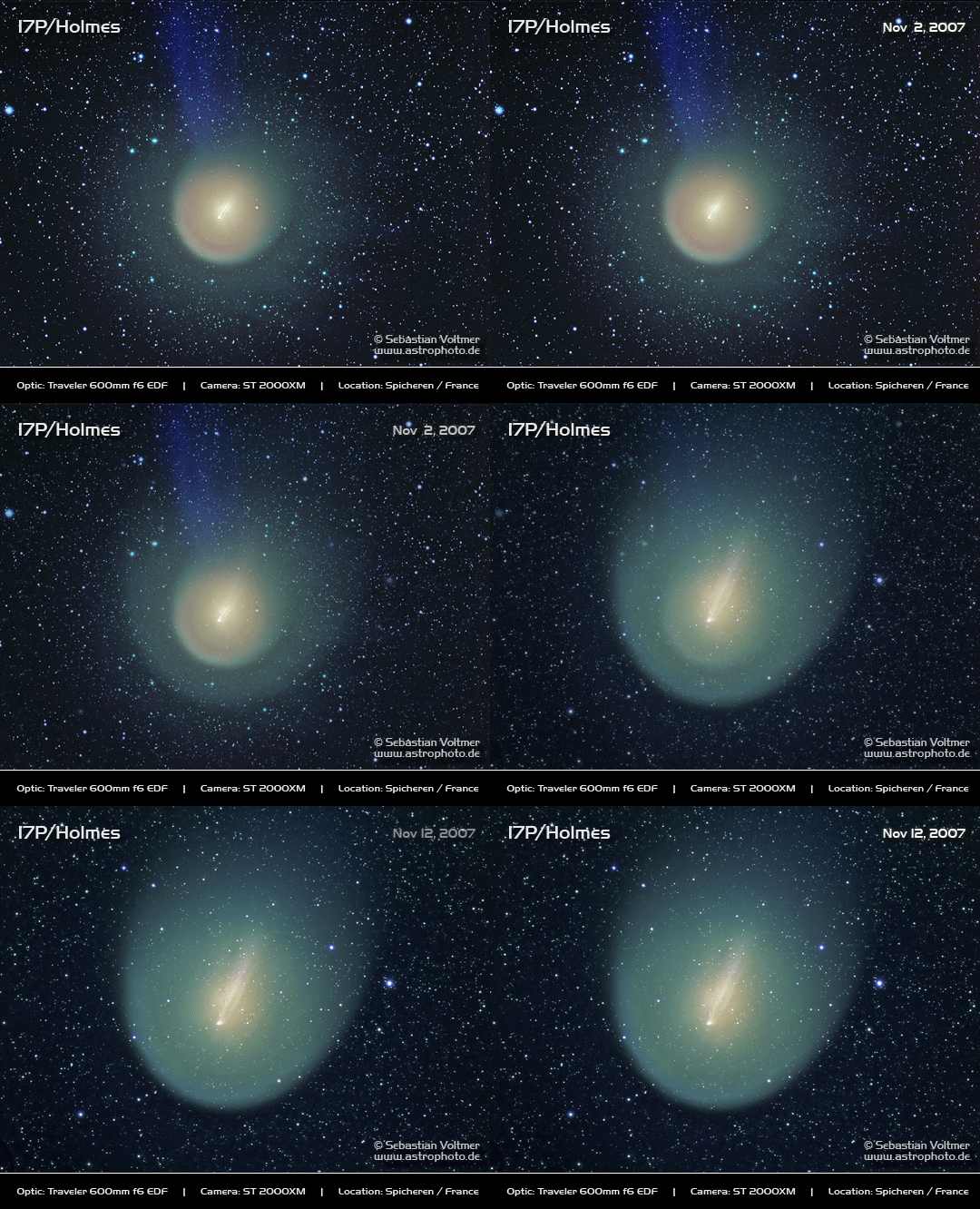
Comet Holmes now bigger than the the sun!
From astronomer David Jewett's page:
...Formerly, the Sun was the largest object in the Solar System. Now, comet 17P/Holmes holds that distinction...Spectacular outbursting comet 17P/Holmes exploded in size and brightness on October 24. It continues to expand and is now the largest single object in the Solar system, being bigger than the Sun (see Figure). The diameter of the tenuous dust atmosphere of the comet was measured at 1.4 million kilometers...
The "Goblin" comet could almost gobble up the sun!
(photo, Sebastian Voltmer, Spichern, France.)
Friday, November 9, 2007
Tail Breaks off Comet Holmes

It's been cloudy here the last day, so I've missed this turn of events. But the Goblin Comet is sure putting on a light show! To the unaided eye, it still looks like a blurry star. Yet just about any optical aid, such as a pair of binoculars or small telescope, will really much greater detail. From SpaceWeather.com:
...COMET TAIL: Exploding Comet 17P/Holmes continues to amaze onlookers. On Nov. 8th and 9th part of the comet's blue tail broke away in view of many backyard telescopes. Visit http://spaceweather.com to see photos of the "disconnection event" and speculation about what might have caused it...
Wednesday, October 31, 2007
Real Hogwarts to open
Wiccan lottery winner plans to open witch school
Bunky is keeping his promise to the Lady and Lord! You know it's a good Sabbat when we have a comet in the sky and someone figures how to piss-off the Xtain Right even more:
...Wiccan high priest Elwood "Bunky" Bartlett, who won an estimated $49 million in the Maryland lottery last month, intends to use his money to set up a school for witches -- a real-life Hogwarts...Bartlett has already contributed to a Special Olympics event, to Mystickal Voyage, a New Age shop where he currently teaches, and to a Stonehenge preservation group in England...
Tuesday, October 30, 2007
Goblin Comet for Samhain
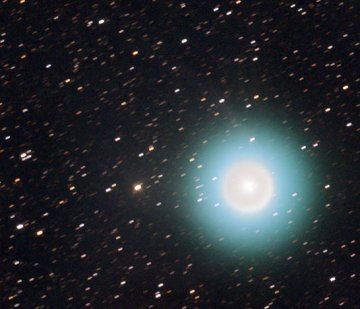
We have a naked-eye visible comet gracing our skies for Samhain! Some have dubbed it the 'Goblin Comet'. Last night, the comet was an easy target through binoculars, and looked spectacular in my Astroscan. It's easy to spot in the constellation Perseus (in the early evening, this is in the North Eastern sky):
From SpaceWeather.com:
...Last week, Comet 17P/Holmes shocked sky watchers around the world with a sudden million-fold increase in brightness. It literally exploded into view, rapidly becoming a naked eye "star" in the constellation Perseus. Since then the comet has expanded dramatically. It is now physically larger than the planet Jupiter and subtends an angle in the night sky similar to the Moon's Sea of Tranquility, the right eye of the "Man in the Moon." Photographers, this amazing comet is an excellent target for off-the-shelf digital cameras and backyard telescopes. It grows visibly from night to night and no one knows how large it will become...
See SpaceWeather.com for skymaps and all the latest info.
Friday, August 3, 2007
Witch's Broom studied by Hubble

Veil Nebula Pierced by Hubble's Gaze
Saw a post about this over at toomanytribbles. The Veil Nebula (aka: 'The Witch's Broom') has been studied in detail by the Hubble Space telescope:
...The Hubble close-ups reveal the rope-like filaments of gas in the nebula, which resulted from enormous amounts of dusty debris plowing into gaseous surroundings. Thicker filaments of material result from viewing the supernova's shock wave edge-on, while more wispy and diffuse views correspond to a face-on view of other parts of the shock wave from Earth...
Check out the link for a number of great photos.
Friday, July 6, 2007
Get out your Telescopes

Fun for backyard observers:
Jupiter is Changing its Stripes Right in Front of Our Eyes
It always pays to keep an eye on Jupiter. According to posters at astronomy forums, these disruptions are visible in medium size telescope. My back is still a bit too tender to risk lugging my SCT (a C-8, made in Celestron's 'PowerStar' era) into the back yard, but I should be able to do so in a few days.
Tuesday, May 15, 2007
Webb Telescope

Nasa unveils Hubble's successor
...The James Webb Space Telescope (JWST) is intended to replace the ageing Hubble telescope. It will be larger than its predecessor, sit farther from Earth and have a giant mirror to enable it to see more...
Sunday, January 28, 2007
Journey to the Seventh, er ah...Sixth Planet

The Saturn view I've been waiting for
Woah! Pass the bong...
...Over the weekend, Cassini acquired a set of images that will (I am assuming) eventually be used to produce a glorious portrait of the ringed planet from a point of view that's never been seen before...
Subscribe to:
Posts (Atom)